
Translating with Sprinky AI...
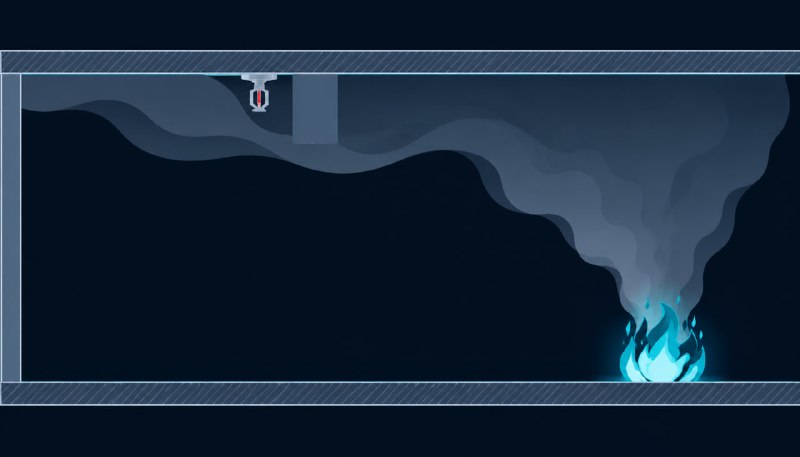
Sprinky AI Translation AssistantA nearby obstruction can interfere with sprinkler discharge even when water can pass around it. The important question is not simply whether the obstruction blocks the sprinkler, but whether it prevents the spray pattern from developing effectively.
The three times and four times rules address this situation. Applying them correctly requires more than multiplying an obstruction dimension. We also need to consider its vertical position, the sprinkler type, the available clear distance and the exceptions that may apply.
These examples explain the principles behind the rules. For a project-specific design, check the applicable edition of NFPA 13 and the requirements of the authority having jurisdiction, or AHJ.
Key Takeaways
- Check the 18 in. vertical condition before applying either obstruction-clearance multiplier.
- Standard spray sprinklers use three times the obstruction dimension; extended coverage and residential sprinklers use four.
- Opposite-side sprinklers must sufficiently reduce shadow area, not merely occupy an apparently opposite position.
- The nonstructural-element allowance for light and ordinary hazards applies to standard spray sprinklers, not extended coverage sprinklers.
Table of Contents
- Start with the 18 in. Vertical Distance
- The Three Times Rule for Standard Spray Sprinklers
- Four Exceptions to the Three Times Rule
- The Four Times Rule for Extended Coverage and Residential Sprinklers
- Applying the Rules in NSVCad: A Parking-Area Example
- A Practical Sequence for Obstruction Checks
Start with the 18 in. Vertical Distance
Before calculating any clearance, establish where the obstruction sits relative to the sprinkler deflector.
The situation considered here has two defining features:
- Any part of the obstruction is within 18 in. vertically of the sprinkler deflector.
- Water can pass on both sides of the obstruction.
This differs from the beam-rule situation in which the available path for water is beneath the obstruction. The geometry determines which obstruction provisions we need to examine.
For standard spray sprinklers, the relevant multiplier is three. For extended coverage and residential sprinklers, it is four. In both cases, the objective is to protect the formation and effectiveness of the discharge pattern.
The Three Times Rule for Standard Spray Sprinklers
Where the three times rule applies, the sprinkler must be separated from the obstruction by a minimum distance equal to three times the obstruction’s largest cross-sectional dimension.
Required clear distance = 3 × largest obstruction dimension
Consider an open-web joist whose openings make up at least 70% of its cross-sectional area. Water can pass through the open web and around both sides of the bottom flange.
Assume the bottom flange is:
- 5 in. wide.
- 1 in. deep.
The governing dimension is 5 in., not 1 in. Multiplying by three gives a minimum clear distance of 15 in. from the bottom flange.
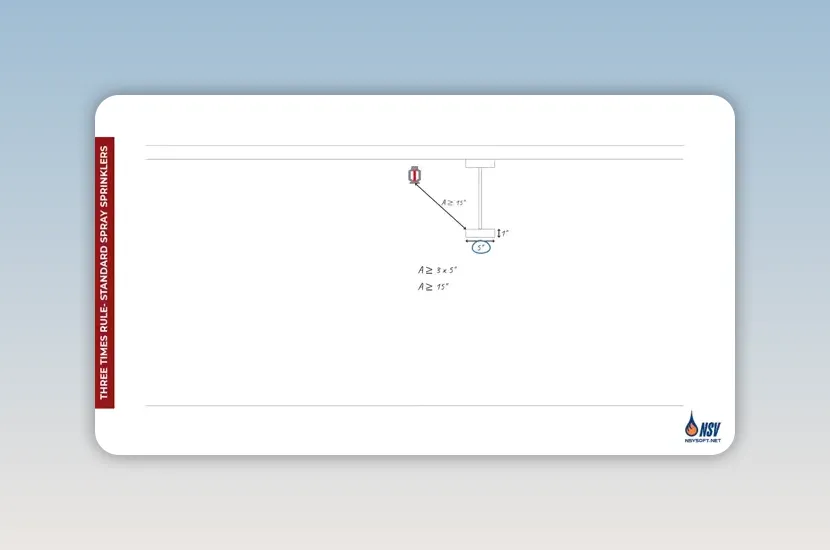
This example illustrates an important distinction: for the qualifying open-web arrangement, we assess the flange that obstructs discharge rather than automatically using the full joist depth.
Four Exceptions to the Three Times Rule
1. Maximum Clear Distance for Horizontal Obstructions
For horizontal obstructions, the three times calculation does not keep increasing the required separation indefinitely. The maximum clear distance discussed here is 24 in. Once the sprinkler is more than 24 in. clear of the horizontal obstruction, the three times rule can be disregarded.
For example, a cable tray 12 in. wide would produce a calculated clearance of:
3 × 12 in. = 36 in.
However, placing the sprinkler more than 24 in. clear of the tray allows the maximum-clear-distance provision to be used instead. This gives greater flexibility than insisting on the full 36 in. calculated distance.
Another way to approach the check is to ask whether the horizontal obstruction is within 24 in. of the sprinkler. If it is, examine the three times relationship and any applicable exceptions. If the clear distance exceeds 24 in., this particular multiplier requirement no longer governs.
Why Sprinkler Height Can Change the Result
Clear distance is only part of the assessment. The 18 in. vertical condition still matters.
Assume an unobstructed-construction example in which the standard spray sprinkler deflector can be positioned between 1 and 12 in. below the ceiling. A cable tray is installed 21 in. below the ceiling.
If we draw only the 24 in. clearance boundary around the tray, it appears to remove a substantial part of the available sprinkler-placement zone. But that is not the whole picture.
Positioning the deflector more than 18 in. above the tray takes the tray outside the vertical zone for the three times rule. In this example, a deflector less than 3 in. below the ceiling provides that separation.
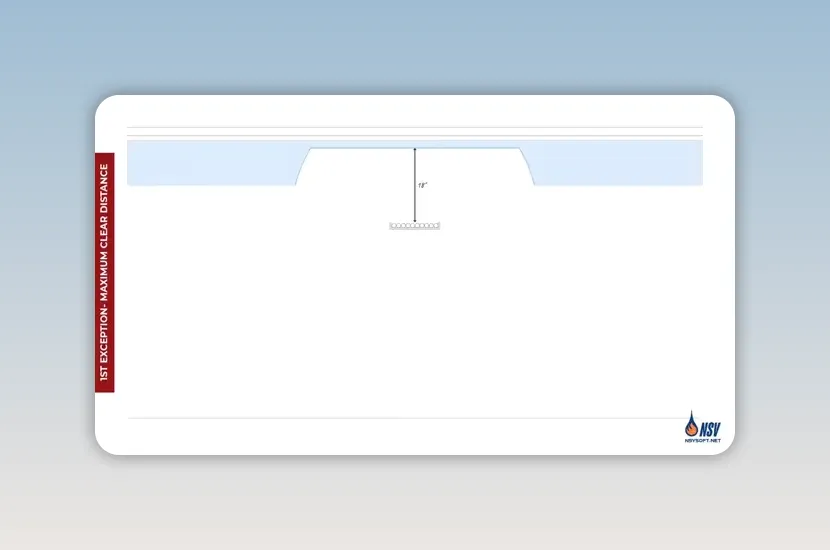
Moving a sprinkler closer to the ceiling can therefore reduce the impact of a nearby obstruction. It does not eliminate the need to check other applicable installation and obstruction requirements.
There is also an important edition distinction: starting with the 2016 edition of NFPA 13, the maximum-clear-distance allowance no longer applies to vertical obstructions such as columns. Do not transfer the horizontal-obstruction limit to a column assessment.
2. An Additional Sprinkler on the Opposite Side
For an obstruction no more than 4 ft wide, the three times rule may be disregarded when an additional sprinkler is installed on the opposite side. The distance from that additional sprinkler to the obstruction’s centreline must not exceed half the allowable spacing between sprinklers.
For a horizontal obstruction, the idea of an opposite side is relatively straightforward. For a column, it needs more thought.
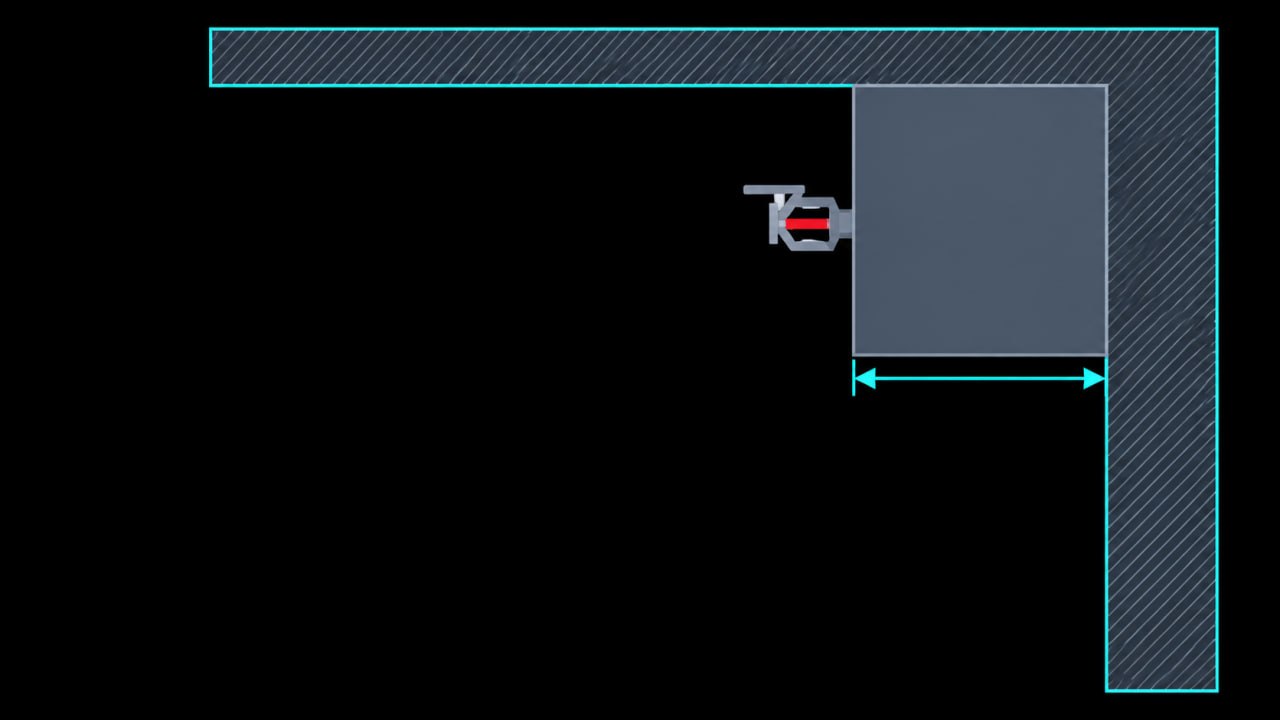
Imagine a sprinkler located 6 in. from a column measuring 2 ft by 2 ft. Several surrounding sprinklers could appear to be on the other side. Which one actually satisfies the purpose of the allowance?
The answer depends on the shadow area: the area that the obstruction prevents the original sprinkler from reaching. The additional sprinkler should sufficiently reduce that shadow, rather than merely occupy a position that looks opposite in plan.
Evaluating the Shadow Area with the Isman Method
The Isman method provides a way to quantify shadow area and compare it with an acceptable limit. It can be used to assess both standard spray and extended coverage sprinkler arrangements. It is an analytical approach to evaluating the remaining shadow, not simply a visual judgement about sprinkler position.
Consider the 2 ft by 2 ft column example in a light hazard occupancy, using a maximum coverage area of 225 sq ft per standard spray sprinkler. The original sprinkler produces a calculated shadow area of 79.8 sq ft, which exceeds the acceptable limit used in the assessment.
We can then test nine candidate positions for the additional sprinkler:
- Position 1: Covers part of the shadow, but leaves too much remaining shadow area.
- Position 2: Covers more of the shadow than position 1, but still does not reduce it sufficiently.
- Position 3: Improves coverage further, but the remaining shadow still exceeds the limit.
- Position 4: Reduces the remaining shadow to 7.5 sq ft, below the threshold used in this example.
- Position 5: Provides the greatest shadow coverage and may be the best choice in this arrangement.
- Position 6: Is acceptable by symmetry with position 4.
- Positions 7, 8 and 9: Do not sufficiently minimise the shadow area.
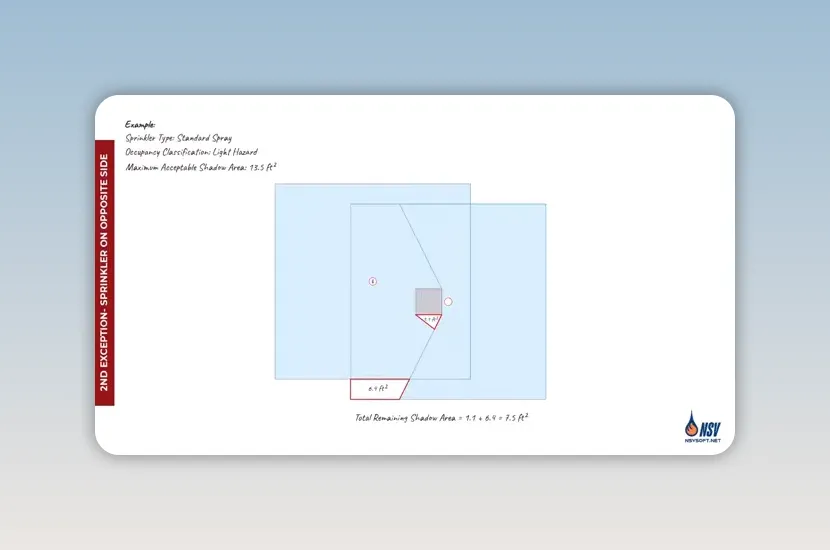
The practical lesson is that opposite side describes a coverage function, not just a direction. A candidate sprinkler must address the shadow created by the obstruction while also meeting the applicable spacing conditions.
3. Certain Nonstructural Elements in Light and Ordinary Hazard Occupancies
An exception introduced in the 1999 edition of NFPA 13 allows certain nonstructural elements to be exempted from the three times rule for standard spray sprinklers in light and ordinary hazard occupancies. Examples include:
- Signs.
- Lighting fixtures.
- Cable trays.
- Pipes.
- Ducts.
The reasoning recognises a practical coordination issue: these elements are often not finalised during the initial sprinkler layout and may be added after sprinkler installation. Fire incident data also indicated that they rarely contributed to large-loss fires.
However, an exemption from the multiplier does not mean the element can be ignored. Annex A explains that these elements should not conceal, obscure or obstruct sprinkler discharge. Interpreting that condition is within the AHJ’s discretion.
This allowance applies to standard spray sprinklers. It does not extend to extended coverage sprinklers or other sprinkler types simply because the occupancy is light or ordinary hazard.
A Duct Still Needs a Discharge-Pattern Assessment
Consider a sprinkler installed just above a 3 ft wide duct. Even where the nonstructural-element allowance is relevant, the duct may interfere with the developing spray pattern.
The actual discharge pattern depends on available pressure. For an approximate visual assessment, the beam-rule table and its corresponding A and B dimensions can be used to illustrate the expected discharge envelope.
Raising the sprinkler towards the ceiling can reduce the duct’s interference, but the AHJ ultimately determines the acceptable arrangement. Where the deflector is more than 18 in. above the duct’s top surface, the duct falls outside the vertical zone for this particular three times check. Other applicable obstruction provisions still need consideration.
4. Sprinkler Piping Less Than 3 in. in Diameter
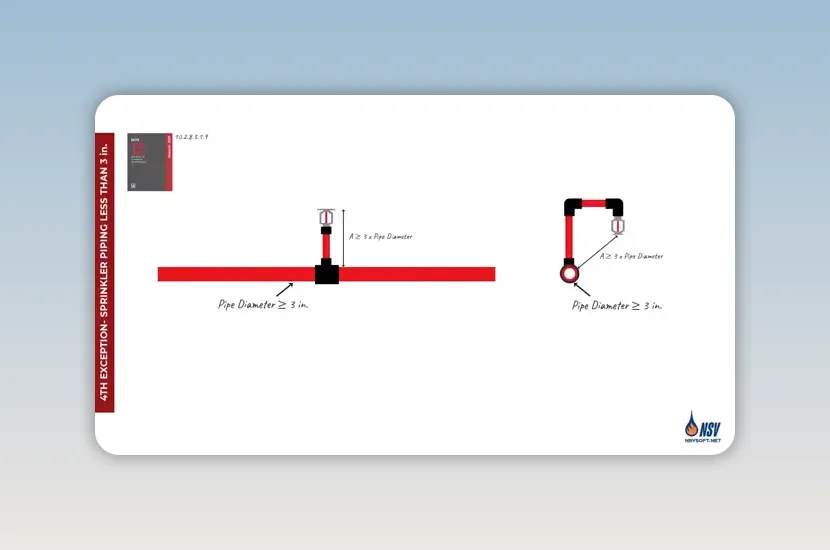
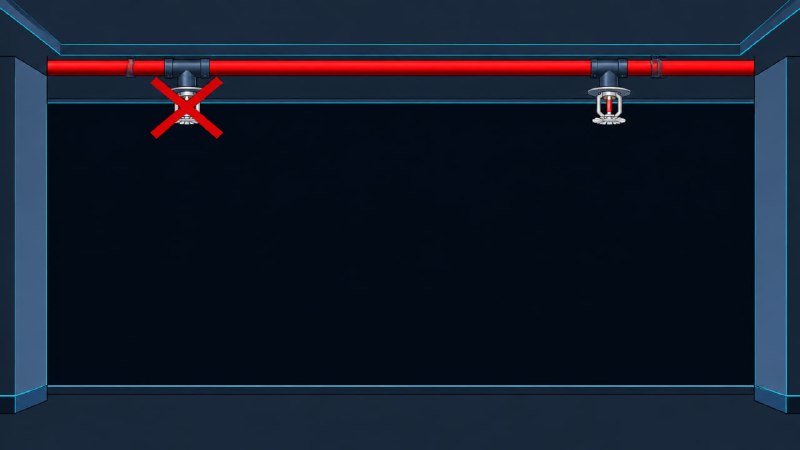
Sprinkler piping less than 3 in. in diameter is exempt from the three times rule. This commonly applies to smaller branch-line piping.
For sprinkler piping 3 in. in diameter or larger, the three times rule applies where the relevant obstruction conditions are present. A sprinkler mounted too close to the larger pipe can have its discharge obstructed.
A sprig or armover can provide the necessary separation, allowing the sprinkler to achieve clearance equal to three times the pipe diameter.
The Four Times Rule for Extended Coverage and Residential Sprinklers
For extended coverage and residential sprinklers, the same basic obstruction situation calls for a different multiplier. Where the obstruction is within 18 in. vertically of the deflector and water can pass on both sides, use four times the obstruction’s largest cross-sectional dimension.
Required clear distance = 4 × largest obstruction dimension
The main distinctions are:
- Horizontal obstructions: The maximum clear distance is 36 in., rather than the 24 in. used for standard spray sprinklers.
- Vertical obstructions: There is no specified maximum-clear-distance limit to substitute for the multiplier.
- Opposite-side sprinklers: An allowance is available, subject to the applicable conditions.
- Small piping: The piping exception for diameters less than 3 in. is also relevant.
- Nonstructural elements: The light and ordinary hazard allowance described for standard spray sprinklers does not apply.
That last distinction can significantly affect sprinkler selection. In a mechanical room with numerous pipes and ducts, standard spray sprinklers may offer more layout flexibility because the nonstructural-element allowance is available to that sprinkler type.
The sprinkler type must therefore be established before applying the obstruction rules. We cannot assume that an exception used for a standard spray layout remains available when changing to extended coverage sprinklers.
Applying the Rules in NSVCad: A Parking-Area Example
A software-assisted example brings the vertical and plan-view geometry together. Consider a parking area with:
- An overall size of 80 ft by 60 ft.
- Twelve columns, each measuring 2 ft by 2 ft.
- One cable tray, 6 in. wide, located 22 in. below the ceiling.
- Extended coverage sprinklers with deflectors 6 in. below the ceiling.
The columns and tray are already defined in NSVCad, so the task is to configure the sprinkler criteria and assess possible locations.
- Enter the design criteria. Select the standard edition, sprinkler type and coverage area, and enter the deflector-to-ceiling distance.
- Apply the correct multiplier. Selecting extended coverage sprinklers causes the software to use the four times rule.
- Check the columns. As a sprinkler approaches a column, the software calculates the permitted clearance. Moving too close produces a highlighted shadow area behind the column.
- Check the cable tray. The software accounts for the vertical separation when calculating the required plan-view offset.
Why 24 in. of Clear Distance Becomes 17.88 in. in Plan
The cable tray’s governing dimension is 6 in. Applying the four times rule gives:
4 × 6 in. = 24 in. minimum straight-line clearance
The deflector is 6 in. below the ceiling and the tray is 22 in. below it. Their vertical separation is therefore:
22 in. − 6 in. = 16 in.
Because that vertical separation is within 18 in., the four times rule remains relevant. But the required 24 in. straight-line clearance is not the same as a 24 in. horizontal offset.
Using the Pythagorean relationship:
Horizontal clearance = √(24² − 16²) = 17.88 in.
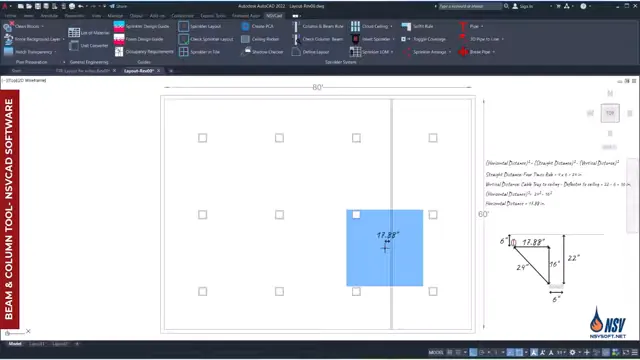
NSVCad calculates this relationship automatically. The example shows why a plan-only assessment can be misleading: we need the elevation information to translate a required straight-line clearance into the correct horizontal distance.
A Practical Sequence for Obstruction Checks
The most reliable approach is to establish the geometry before looking for an exception:
- Identify the sprinkler type and applicable standard edition.
- Check whether any part of the obstruction lies within 18 in. vertically of the deflector.
- Confirm whether water can pass on both sides.
- Use the largest relevant cross-sectional dimension and apply the correct multiplier.
- Consider the horizontal maximum-clear-distance provision and any applicable exceptions.
- Where relying on another sprinkler, assess the remaining shadow area rather than position alone.
- Resolve discretionary nonstructural-obstruction questions with the AHJ.
The multiplication is straightforward. Choosing the right rule, measuring the right distance and applying the right exception are what make the layout work.
Try NSVCad for Sprinkler Obstruction Analysis
Explore software-assisted clearance calculations and shadow-area checks with the NSVCad Sprinkler Module.

No comments yet. Be the first to share your thoughts!