
Translating with Sprinky AI...
Sprinky AI Translation AssistantA ceiling pocket does not always need its own sprinkler. When the applicable NFPA conditions are satisfied, sprinklers at the lower ceiling level can protect the room without additional sprinklers inside the recess. Recognising that allowance can reduce unnecessary sprinkler placements and improve the efficiency of a fire sprinkler layout.
The key is to evaluate more than the pocket’s dimensions. Sprinkler type, interior finishes, nearby pockets and full floor coverage all influence whether omission is permitted.
Key Takeaways
- Ceiling pocket omission requires both qualifying pocket conditions and full floor coverage from lower-level sprinklers.
- Residential sprinkler pocket limits differ from those for quick-response standard spray and extended coverage sprinklers.
- Nearby pockets may require a combined-volume check rather than separate assessments.
- NSVCad automates dimensional checks, but sprinkler positioning and shadow areas still need review.
Table of Contents
- What Is a Ceiling Pocket?
- How Pocket Dimensions Influence Fire Control
- NFPA 13: Standard Spray and Extended Coverage Sprinklers
- Residential Sprinklers: NFPA 13, 13R and 13D
- Applying Ceiling Pocket Requirements in NSVCad
- Make Ceiling Pocket Checks Part of the Design Process
What Is a Ceiling Pocket?
A ceiling pocket is a recessed section of ceiling that sits above the surrounding ceiling level, typically within defined boundaries. A raised central ceiling bounded by lower soffits is a common example.
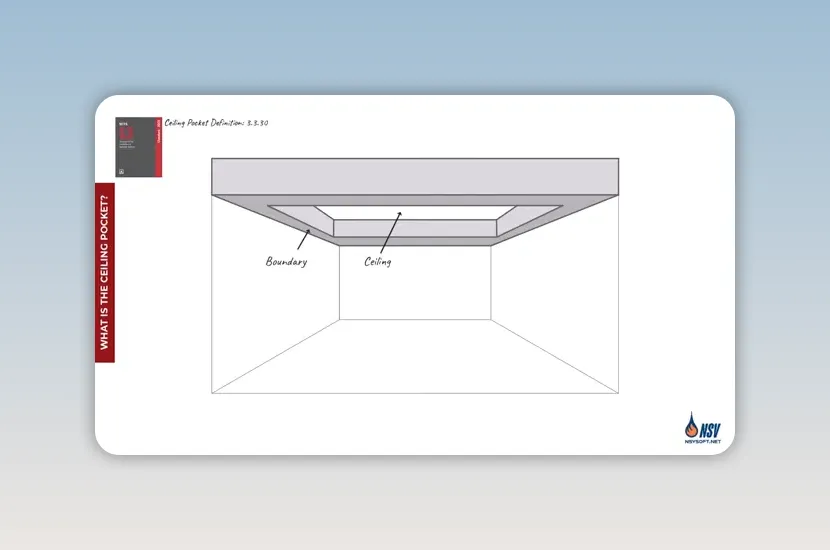
From a sprinkler design perspective, the important question is whether heat can collect in that higher space and delay the operation of sprinklers installed below it. This is why ceiling pocket allowances depend on both geometry and the type of sprinkler protecting the compartment.
How Pocket Dimensions Influence Fire Control
When a fire starts in a compartment, buoyancy carries hot gases and smoke upwards. They reach the ceiling and spread, forming a hot layer that deepens as the fire grows.
If a ceiling pocket has a small depth or volume, sprinklers at the lower ceiling level can generally respond promptly enough to control the fire. A more substantial pocket can retain heat above those sprinklers, delaying activation and allowing further fire growth.
The omission allowance is therefore conditional, not a general exemption for recessed ceilings. The pocket must meet the applicable criteria, and the sprinklers below it must still protect the entire floor area.
NFPA 13: Standard Spray and Extended Coverage Sprinklers
Where quick-response standard spray or extended coverage sprinklers are installed throughout the compartment, NFPA 13 permits sprinklers to be omitted from a ceiling pocket when all the following conditions are satisfied:
- Finishes: The pocket has non-combustible or limited-combustible finishes.
- Volume: The pocket volume does not exceed 1,000 cubic feet.
- Depth: The pocket depth does not exceed 36 inches.
- Coverage: Sprinklers at the lower ceiling level can protect the entire floor area.
These conditions work together. A shallow pocket does not qualify simply because it meets the depth limit, nor does a small volume remove the need to check finishes and coverage.
Worked Example: A 120-Cubic-Foot Pocket
Consider a square room with a raised ceiling between two soffits. Assume that the pocket has non-combustible finishes.
- Calculate the depth. Subtract the soffit underside height from the higher ceiling height. In this example, the difference is 2 feet.
- Calculate the volume. Multiply the pocket’s length, width and depth. The resulting volume is 120 cubic feet.
- Compare the dimensions with the limits. A depth of 2 feet is below 36 inches, and 120 cubic feet is below 1,000 cubic feet.
- Check the sprinkler layout. Confirm that quick-response sprinklers below the soffit can protect the full floor area.
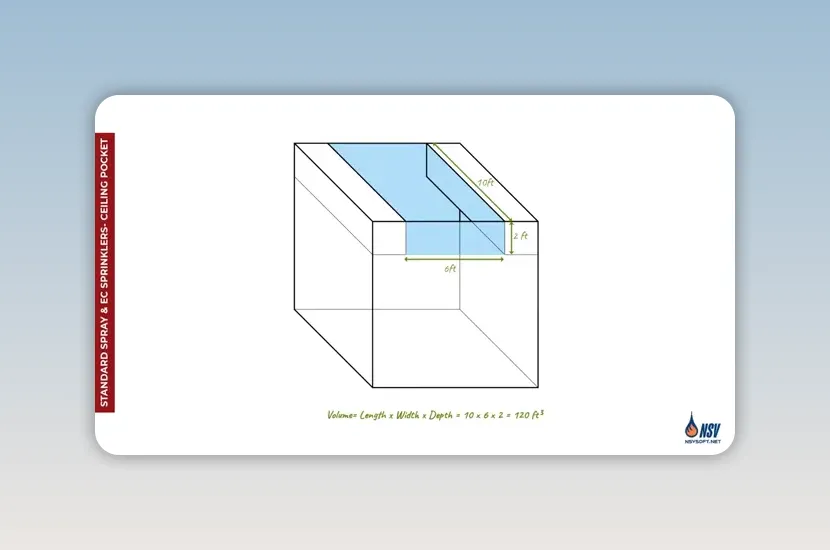
For the light-hazard room in this example, applying the small room rule allows one standard spray sprinkler to protect the space. That conclusion depends on the room and sprinkler arrangement satisfying the applicable small room provisions.
Without considering the ceiling pocket allowance, the illustrated layout would require at least two sprinklers. The absence of a suspended ceiling also makes the available installation locations important. Checking the allowance creates an opportunity to simplify the layout without leaving the floor unprotected.
Multiple Pockets Within the Same Compartment
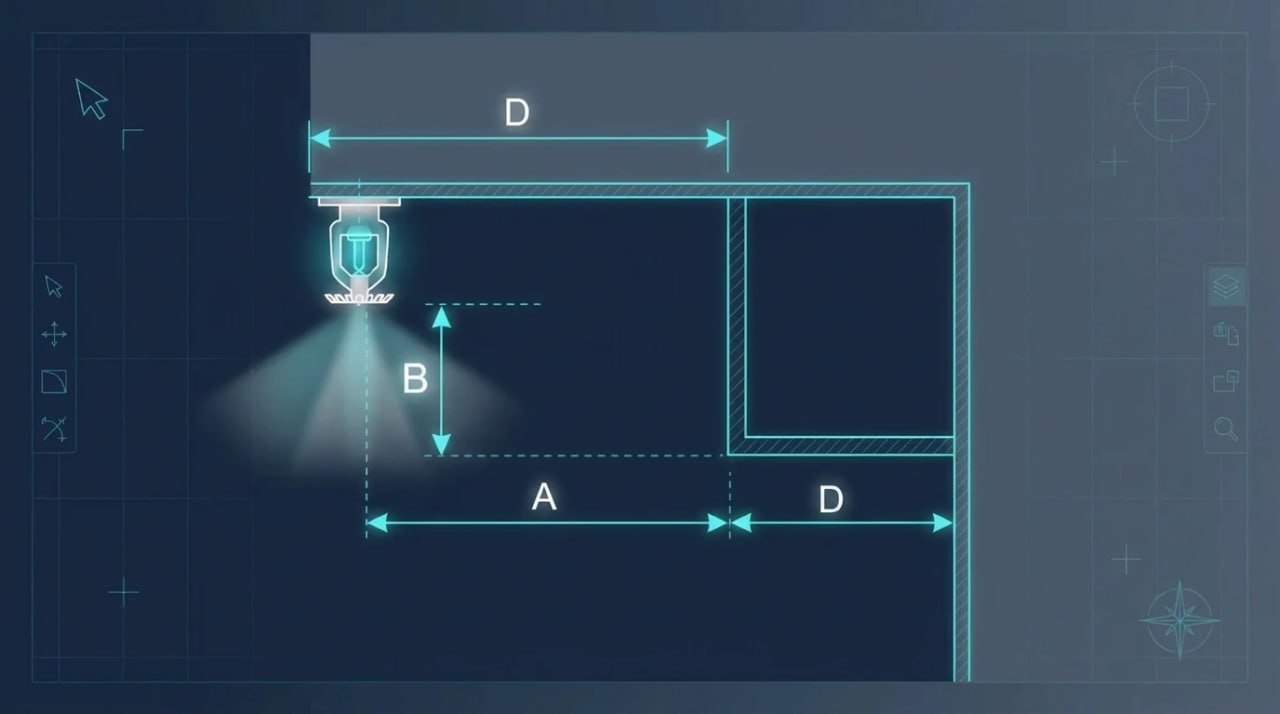
Nearby pockets cannot always be assessed independently. When multiple ceiling pockets in the same compartment are within 10 feet of each other, their combined volume must not exceed 1,000 cubic feet for this allowance.
The other conditions still apply: maximum depth, acceptable finishes and complete floor coverage from sprinklers at the lower ceiling level. Checking each pocket separately could miss a combined-volume restriction.
Residential Sprinklers: NFPA 13, 13R and 13D
Residential sprinkler provisions follow the same basic principle, but the dimensional criteria differ from those for quick-response standard spray and extended coverage sprinklers.
NFPA 13 and NFPA 13R
For residential sprinklers under NFPA 13 and NFPA 13R, the ceiling pocket dimensional limits for omission are:
- Maximum depth: 12 inches.
- Maximum volume: 100 cubic feet.
These are substantially smaller allowances than the 36-inch depth and 1,000-cubic-foot volume discussed above. Do not transfer the standard spray criteria to a residential sprinkler layout.
NFPA 13D
NFPA 13D differs in two important respects: it does not specify a ceiling pocket depth limit, and the combustibility of decorative interior finishes within the pocket is not a restricting factor for this allowance.
Those differences should not be interpreted as removing every other condition. The applicable NFPA 13D omission provisions still need to be checked.
Across NFPA 13, NFPA 13R and NFPA 13D, residential sprinklers at the lower ceiling level must be capable of covering the entire floor area. Meeting a pocket’s dimensional criteria is only part of the design check.
For project use, confirm the complete provisions in the applicable edition through the NFPA codes and standards resources. The software example below uses the 2025 edition of NFPA 13.
Applying Ceiling Pocket Requirements in NSVCad
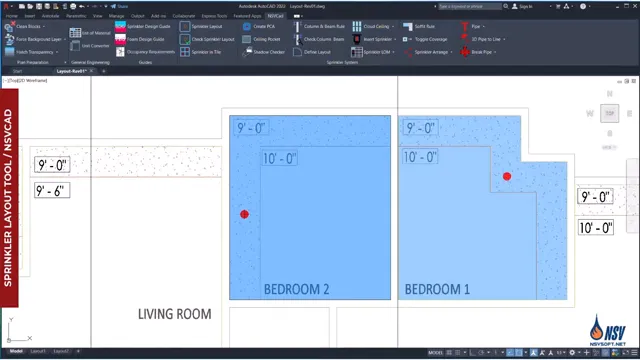
NSVCad can help identify qualifying pockets during sprinkler layout, reducing the chance of overlooking the allowance across a large project. Consider two bedrooms requiring residential sprinkler protection.
Because the rooms have no suspended ceilings, the initial approach uses sidewall sprinklers. Applying the ceiling pocket allowance then opens up an alternative: a pendent sprinkler beneath a soffit.
Bedroom 1: Check the Pocket, Then Optimise Coverage
Selecting the room allows the software to calculate the ceiling pocket’s depth and volume. If those values fall within the acceptable range, a notification confirms that the ceiling pocket allowance can be applied.
Assuming non-combustible pocket finishes, the workflow is:
- Review the calculated pocket dimensions and the allowance notification.
- Apply the allowance.
- Allow the software to place a pendent sprinkler beneath the soffit.
- Adjust the sprinkler position to achieve full room coverage.
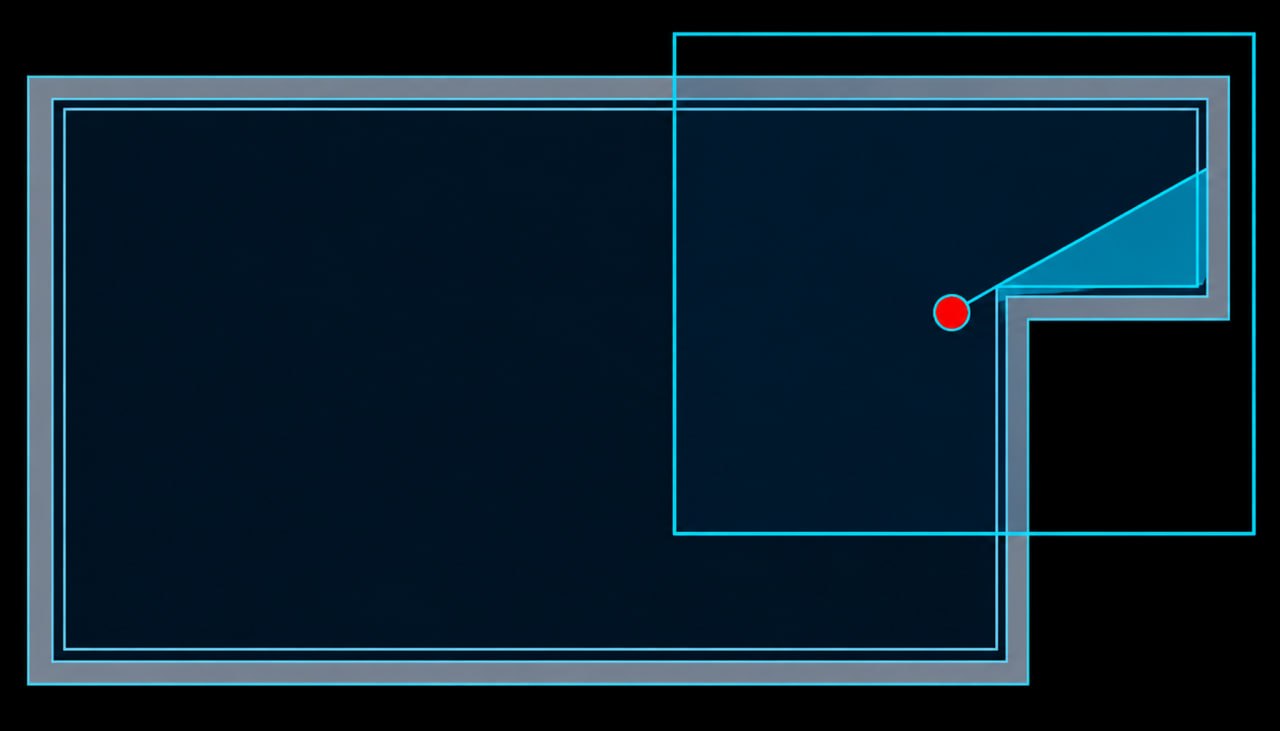
- Check that any shadow areas remain within the limits permitted by NFPA 13.
The final steps matter just as much as the automatic dimensional check. A qualifying pocket does not make every sprinkler position acceptable. The sprinkler must still cover the room, including areas affected by its geometry.
Bedroom 2: The Choice of Soffit Matters
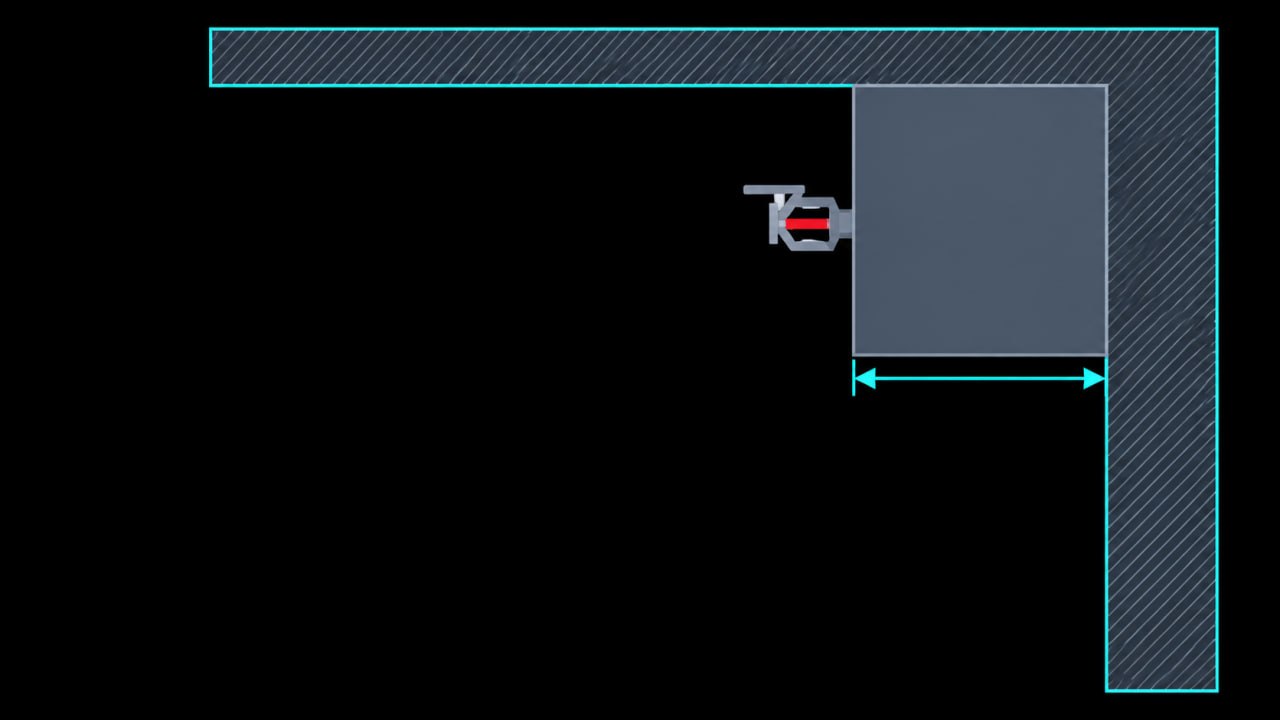
The second bedroom also qualifies for the ceiling pocket allowance, but placing the pendent sprinkler beneath the north soffit leaves the southern portion of the room outside its coverage.
Relocating that sprinkler beneath the west soffit provides full coverage with a single pendent sprinkler. Before adding another sprinkler, it is worth checking whether a different permitted location solves the coverage problem.
Make Ceiling Pocket Checks Part of the Design Process
Ceiling pocket requirements are not conceptually complicated, but they are easy to overlook when a project contains many rooms. Repeated omissions of the allowance can mean repeated opportunities lost to simplify the system.
A reliable review checks the applicable standard and sprinkler type, pocket finishes, depth, volume, nearby pockets and lower-level sprinkler coverage. NSVCad automates the depth and volume checks, while the layout process still requires attention to finishes, positioning and shadow areas.
The objective is not simply fewer sprinklers. It is a compliant layout that avoids unnecessary placements by making proper use of the ceiling pocket provisions.
Try NSVCad for Sprinkler Design
Explore automated ceiling pocket checks and sprinkler coverage tools with a free trial.

No comments yet. Be the first to share your thoughts!