Part 2 — Downsizing effects, flow redistribution, branch-main interaction, and nonlinear hydraulic behavior.
Downsizing Pipes and Its Effect on Hydraulic Demand
While upsizing reduces friction loss, downsizing can sometimes produce the opposite—but beneficial—effect. When pipe diameters are reduced, friction loss increases, pressure decreases along the pipe, upstream sprinklers receive less pressure, and their discharge flow is reduced.
The key result is that total system flow may decrease, even though friction increases. This can be useful when non-governing sprinklers are discharging excess water, total system demand is too high, or available water supply is limited.
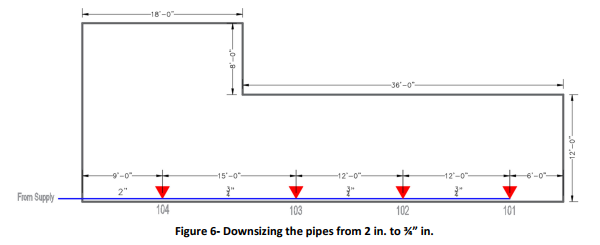
Real Case: Flow Redistribution in a Simple System
Consider a simplified branch line with four sprinklers. Sprinkler 1 is the remote governing sprinkler, while sprinklers 2 through 4 are upstream non-governing sprinklers.
Scenario A: Larger Pipes
With larger pipes, friction loss is lower, pressure at upstream sprinklers remains higher, and sprinklers 2–4 discharge more water. As a result, total system flow increases, the main pipe carries more water, and overall demand rises.
Scenario B: Smaller Pipes
With smaller pipes, friction loss is higher, pressure at upstream sprinklers is reduced, and sprinklers 2–4 discharge less water. The governing sprinkler can still remain satisfied, while total system flow decreases and overall demand is reduced.
Why This Happens (Engineering Explanation)
Sprinkler discharge depends on pressure. When pressure increases, flow increases. When pressure decreases, flow decreases. In larger pipes, pressure losses are small, pressure stays higher throughout the system, and all sprinklers tend to discharge more.
In smaller pipes, pressure drops faster, upstream sprinklers receive less pressure, and their flow is naturally limited. This creates a self-regulating effect that can help reduce excess system demand.
Interaction Between Branch Lines and Mains
Pipe sizing cannot be analyzed in isolation. Branch lines directly feed sprinklers and control individual sprinkler discharge, while cross mains and feed mains carry combined system flow and experience higher total hydraulic loading.
Upsizing branch lines can increase sprinkler flow, and upsizing mains can reduce pressure loss. But when branch-level flow increases, it also increases the load on the mains. This interaction explains why a locally beneficial change may become globally counterproductive.
When Upsizing Becomes Counterproductive
Upsizing is not always beneficial. It becomes counterproductive when upstream sprinkler flow increases significantly, total system flow increases more than friction loss decreases, and main pipe losses rise because of higher combined flow.
The result may be a higher system pressure requirement, a larger required pump, or reduced water supply margin.
Identifying Critical Sections for Optimization
Designers should focus on remote branch lines, long pipe runs, high-flow mains, and sections with high velocity. These are the parts of the system where optimization changes produce the most meaningful hydraulic improvement.
Low-impact zones such as short pipe segments, low-flow sections, or areas close to the supply source generally provide less benefit from aggressive pipe sizing changes.
Practical Design Strategy for Pipe Sizing
- Start with standard code-compliant pipe sizes.
- Analyze hydraulic results and identify high friction loss areas and excessive sprinkler flow.
- Apply selective upsizing where velocity is high and friction loss dominates.
- Apply selective downsizing where flow is excessive and pressure is unnecessarily high.
- Recalculate and compare total flow, required pressure, and system efficiency.
Advanced Insight: Nonlinear System Behavior
Pipe networks are nonlinear because flow depends on pressure, pressure depends on flow, and both influence each other. This creates system-wide feedback, meaning a change to one pipe can affect the entire hydraulic network.
Results are therefore not proportional, which is why hydraulic calculation software is essential for real-world fire sprinkler system design.
FAQ
Why can smaller pipes reduce system demand?
Because they reduce pressure at upstream sprinklers and limit excess flow.
What is flow redistribution?
It is the way water flow shifts between sprinklers when pipe sizes change.
Should all pipes be upsized?
No. Selective sizing is more effective than uniform upsizing.
What is the governing sprinkler?
It is the sprinkler requiring the highest pressure and determining system demand.
Why is pipe sizing nonlinear?
Because pressure and flow depend on each other, creating feedback effects.



No comments yet. Be the first to share your thoughts!