Selecting Design Point from Density/Area Curves:
In many cases, Density/Area curves shall be used to design fire sprinkler systems where CMDA Sprinklers are applied.
For the following conditions, NFPA 13 provides design curves:
- LH/OH/EH occupancies where the hydraulic calculation method is used
- Miscellaneous storage
- Palletized, Solid-Piled, Bin Box, Shelf, or Back to Back Shelf storage of Class I to IV
- Rack Storage of Class I to IV (with storage height Up to 25 ft)
In this text, we survey the pros and cons of each point on the curve.
As it shows in Figure 1 (Design criteria window of “Fire Protection Design software”), NFPA 13 requires Curve D of Figure 16.2.1.3.2(a)-2016 Edition for below conditions:
Double Row Rack Storage, Open Rack Type, Nonencapsulated Class I commodity, Storage height 12 to 20 ft, 4 ft Aisle width, Using CMDA Ordinary temperature with in-Rack sprinkles
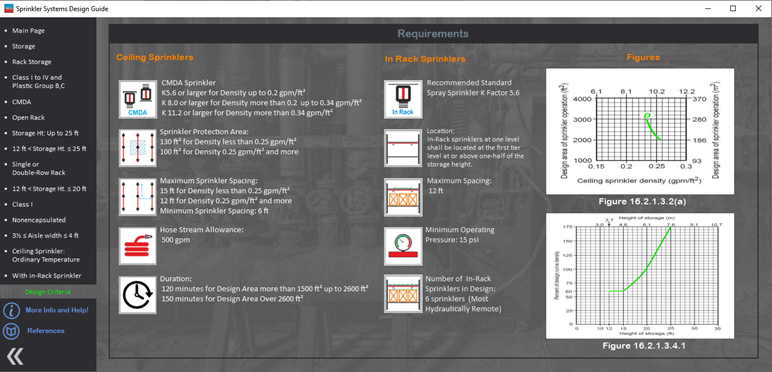
User can apply any point from the curve, for example we consider 3 different points of the curve:
- Lowest Point: Density: 0.255 gpm/ft² and Design area: 2000 ft²
- Midpoint : Density: 0.24 gpm/ft² and Design area: 2500 ft²
- Highest Point : Density: 0.232 gpm/ft² and Design area: 3000 ft²
In most conditions, lower points will be selected because of these advantages:
1) Lower flow rate: when this point is selected, the flow rate will be 510 gpm, on the other hand, for the upper point, the flow rate will be 696 gpm.
Lower flow rate means a smaller pump flow rate and smaller water tank.
(Remember this is a rough estimation because the minor and major loss are not considered.)
2) Less fire damage: by selecting the lower point, the fire will be controlled in a smaller area.
Also, we should remember selecting the upper point of the curve will be helpful in some circumstances.
For example, if the lower point is selected the maximum area coverage of sprinkler will be 100 ft², but for the upper point, the maximum area coverage of each sprinkler will be 130 ft².
The bigger area coverage of sprinklers means the less number of required sprinklers.
For some curves in NFPA 13, selecting upper points will help us to use smaller K Factor or less pressure required upstream of the sprinklers.
Designers shall be considered all the variables for designing the low cost and high- performance systems.
This is the prettiness of designing fire sprinkler systems!

No comments yet. Be the first to share your thoughts!